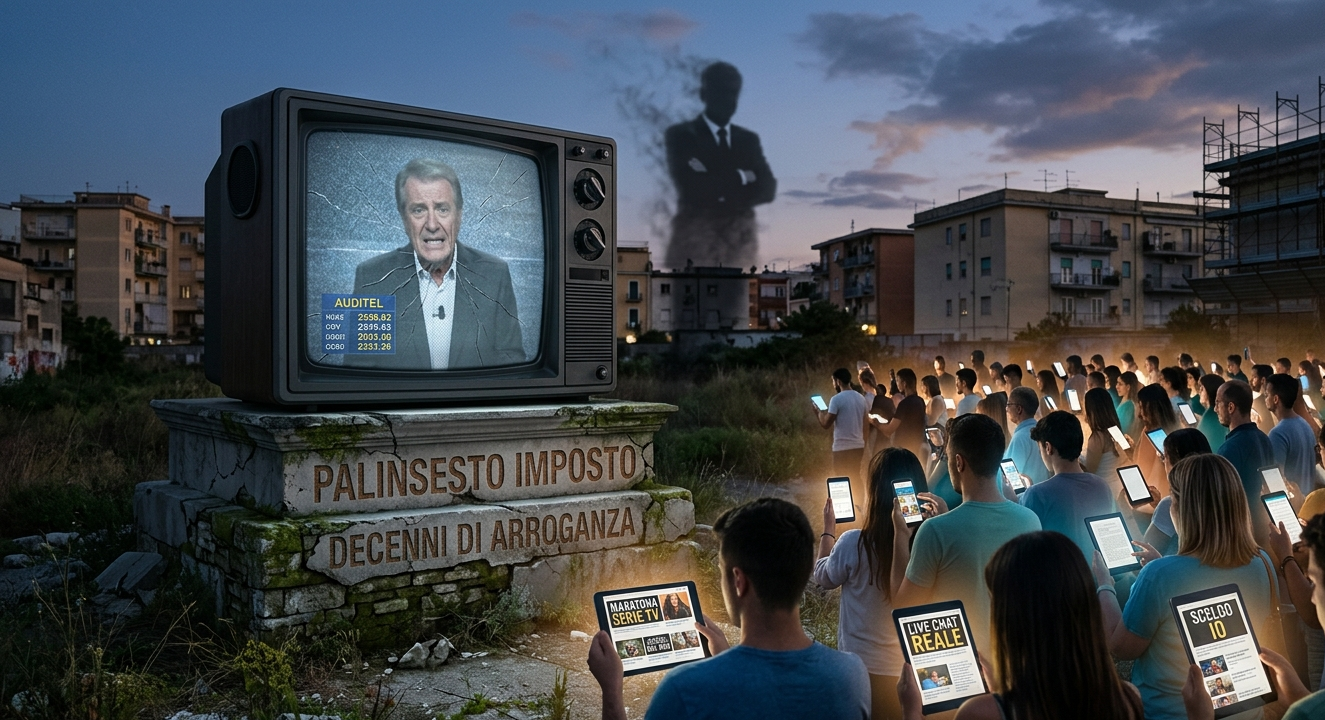
Unplugging the Hubris: Why Traditional TV Fears the Conscious Consumer
By Giuliux Magazine | May 2026
In 2026, the ultimate statement of a sophisticated home isn’t the resolution of the screen, but the vacant port on its back. More and more often, the act of leaving the coaxial antenna cable in the drawer is a quiet revolution. That circular hole on the back of our ultra-thin Smart TVs is becoming an archaeological relic, while Wi-Fi transforms the display into a massive, interactive window. Yet, behind this technological shift lies a deeper cultural war: the clash between the hubris of top-down broadcasting and the newfound autonomy of the Conscious Consumer.
The Illusion of “We Know What You Want”
For decades, legacy network executives operated with an almost messianic arrogance: “We curate the schedule because we alone know what the masses want.” This paternalistic vision turned television into a monologue, where the viewer was treated as a passive vessel—a container to be filled with programs handpicked by an invisible elite. The “policy of force”—imposing rigid time slots and linear schedules—was more than a commercial strategy; it was an act of power. It was the power to dictate the rhythm of time and the focus of thought for millions.
The Rise of the Conscious Consumer
Today, that passive viewer is extinct. In their place is the Conscious Consumer, an individual who refuses to be “fed” at pre-set intervals. The conscious consumer doesn’t wait until next Tuesday for an episode; they migrate to the web for a binge-watching marathon. They don’t just absorb an opinion; they challenge it in real-time. Unplugging the antenna isn’t just a technical choice—it’s the end of submission to an external director. It is a declaration that the remote is no longer a leash, but a tool for critical selection.
Statistical Fiction vs. Digital Reality
Broadcasting hubris has long been sustained by opaque data. For years, the success of a program was dictated by legacy sampling systems—statistical “projections” based on a few thousand “chosen” families intended to represent the entire nation. It was a house of cards designed more to reassure advertisers than to capture reality.
The web has demolished this mystery. On digital platforms, every view is a verified individual, a deliberate click. We no longer “hypothesize” an audience; we conduct a census. Traditional networks deeply fear this precision because it reveals the vast desert of those who have stopped listening to the television monologue.
The “Marble Palace” Effect: Why Big Capital Still Seeks Refuge in TV
Why, then, do banks and global corporations—notoriously obsessed with the bottom line—continue to pour millions into traditional TV spots? Because they share the same fear of the Conscious Consumer. On TV, an ad exists in a protected, sterile environment where no one can talk back. It is the “Marble Palace” of communication: it provides a veneer of institutional solidity that a smartphone banner cannot replicate. These brands pay for the prestige of a captive audience, preferring a silent crowd over a digital one that has the right to rebuttal.
Mediatic Vampirism: A Fear of the Future
The definitive proof of this crisis is the “vampirism” of national networks. After years of mocking web creators and “influencers,” executives are now hiring them in droves for primetime slots. This isn’t an embrace of the new; it’s a move born of panic. They are trying to “buy” the relevance of those who have already built the future elsewhere, hoping that a digital face will lure young audiences back to the antenna. It is a futile effort: a lion in a cage (the network) no longer attracts those accustomed to the open savanna of the internet.
The Fear of the “Live Chat” and the Rebuttal
What traditional TV fears most is real-time accountability. In digital “Live” environments, the chat is the true counter-power. If a speaker lies or bores the audience, the reaction is instantaneous. Legacy TV remains the last sanctuary where one can speak without interruption. This demand for immunity is precisely what is making it irrelevant. The Conscious Consumer no longer wants a pulpit; they want a conversation.
The Final Verdict
The imposed schedule is crumbling under the weight of its own hubris. Without the antenna, the “channels” lose their birthright and become mere icons on a screen, forced to compete on quality rather than position. The future belongs to those who respect the intelligence of the audience, not those who seek to control it. Traditional TV may remain, but only as one playlist among many. The era of “we know what’s best for you” is over. Today, it is the user who says, “I choose what I watch.” And for those at the top, that is a terrifying prospect.